Designing an AI Companion That Reduces the Mental Load of Working Parents. A six-month UX research initiative exploring how AI can support family coordination. Not by making decisions for parents, but by helping them make better ones.

Role
UX Researcher
UX Researcher
Team
Rivers Agile: Product Manager, Engineer, Content Manager
Client
Momentality
Research Methods
Literature Review
Competitive Analysis
7 Interviews
Affinity Mapping
Concept Exploration
Co-design Workshop

Overview
Working parents make hundreds of small decisions every day. Some are obvious: school pickup, dinner, doctor's appointments. Others are invisible: remembering permission slips, coordinating schedules, anticipating conflicts, and keeping track of the countless details that hold a family together.
Many already rely on calendars, reminder apps, school portals, and handwritten notes. Yet the mental effort of keeping everything in sync often falls on one person.
Our team wanted to explore whether AI could meaningfully reduce that mental load.
Rather than starting with a product idea, I started with research. I wanted to understand where the real friction came from—and whether AI had a role to play at all.
The Challenge
Working parents already have calendars, reminder apps, school portals, sticky notes, family group chats... the list goes on.
So why does staying on top of everyday life still feel so overwhelming?
Instead of jumping straight into solutions, I wanted to understand what was actually making family coordination difficult. Was the problem a lack of tools? A lack of information? Or something else entirely?
That question became the starting point for this research.
Research
I interviewed seven working parents—primarily mothers serving as the primary caregiver—to understand what everyday coordination actually looks like behind the scenes.
Rather than validating a feature idea, these conversations focused on routines, breakdowns, support systems, and the role (or lack thereof) that AI currently plays in family life.
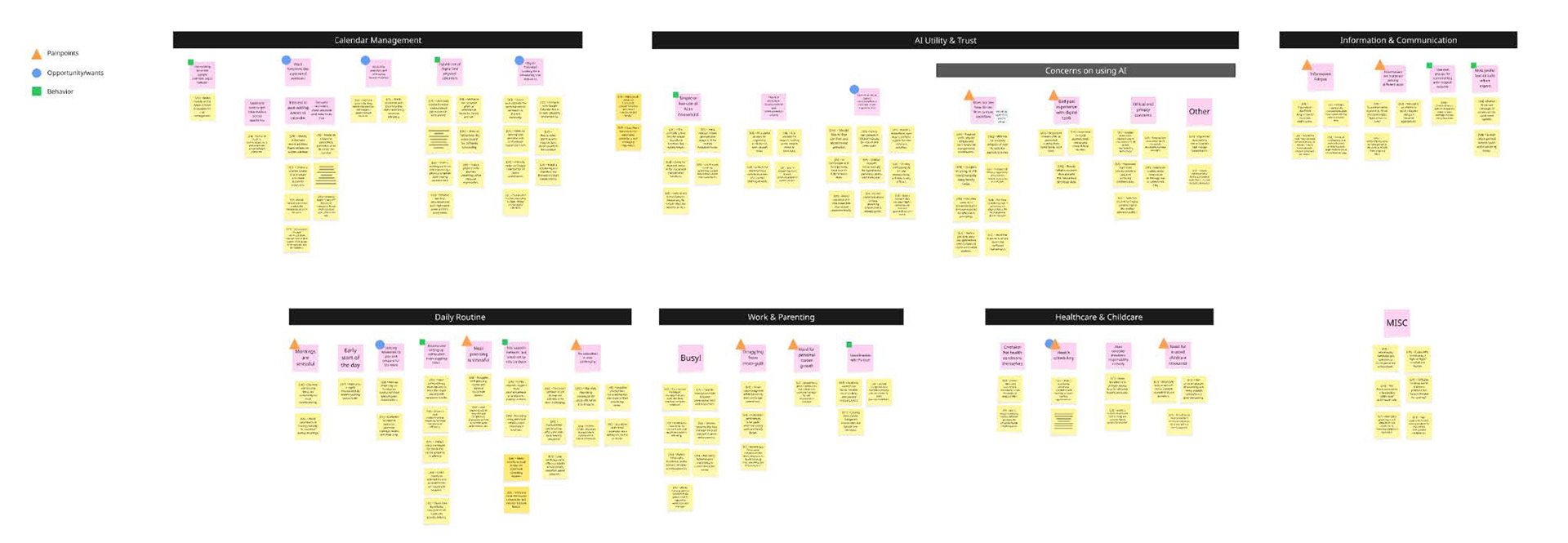
From there, I synthesized observations through affinity mapping to uncover recurring behaviors, emotional patterns, and unmet needs.
What I learned
1. Parents didn't need another app.
Going into the interviews, I assumed the challenge might be around organizing information better.
Instead, I found that most parents already had systems that worked—at least well enough. Google Calendar, Apple Calendar, paper planners, dry-erase boards, text messages, screenshots... Everyone had their own combination.
The problem wasn't that these tools didn't exist.
It was that none of them really worked together.
Parents spent a surprising amount of energy acting as the bridge between disconnected systems—remembering what came from the school email, checking another app for soccer practice, updating the family calendar, then texting their partner about the change.
The coordination itself became part of the work.

Parents merge calendars and information in one spot manually for easier access.
2. AI wasn't the obvious answer.
One thing I didn't expect was how differently participants talked about AI at work versus at home.
Most of them already used AI professionally—for writing, organizing, or summarizing information. But very few had found a meaningful place for it in family life.
It wasn't because they disliked AI. They simply weren't convinced it solved a problem they actually had.
One participant joked,
"Until AI can get my son to take a bath, you're not really helping me."
It reminded me that introducing AI isn't just about adding intelligence. It has to reduce effort in a way people immediately recognize as helpful.

There is a gap between AI usage in the workplace and in the household.
3. More automation isn't always better.
Another assumption I had going into the research was that parents would want AI to automate more of their day.
Instead, participants drew a clear line.
They were excited about AI helping with repetitive tasks like pulling information together, highlighting schedule conflicts, or summarizing updates across different apps. Those were the kinds of tasks that felt tedious but low-risk.
When it came to bigger decisions—childcare, transportation, medical appointments, or family priorities—they still wanted to be the one in control.
The opportunity wasn't to build an AI that managed the family.
It was to build one that helped parents spend less energy gathering information, so they could focus on making the decisions that mattered.
A shift in design direction.
The interviews didn't point us toward building another planner.
Parents already had planning systems. They had calendars, reminders, school apps, family group chats, and handwritten notes. What they were missing wasn't another place to organize information—it was an easier way to make sense of everything already coming their way.
That shifted how I thought about AI's role.
Instead of acting as a personal assistant that manages a family's schedule, AI could work quietly in the background: bringing together information from different sources, surfacing what needs attention, and helping parents feel confident that nothing important had slipped through the cracks.
With that direction in mind, we began exploring concepts that focused on reducing mental load rather than adding another tool to manage.
The early concepts focused on helping parents:
• See important updates and schedule changes at a glance.
• Reduce the effort of piecing together information from multiple sources.
• Catch conflicts before they become stressful.
• Feel more confident that they hadn't overlooked something important.

Design Concepts
The following concepts are early hypotheses informed by research findings and collaborative exploration with the client team.
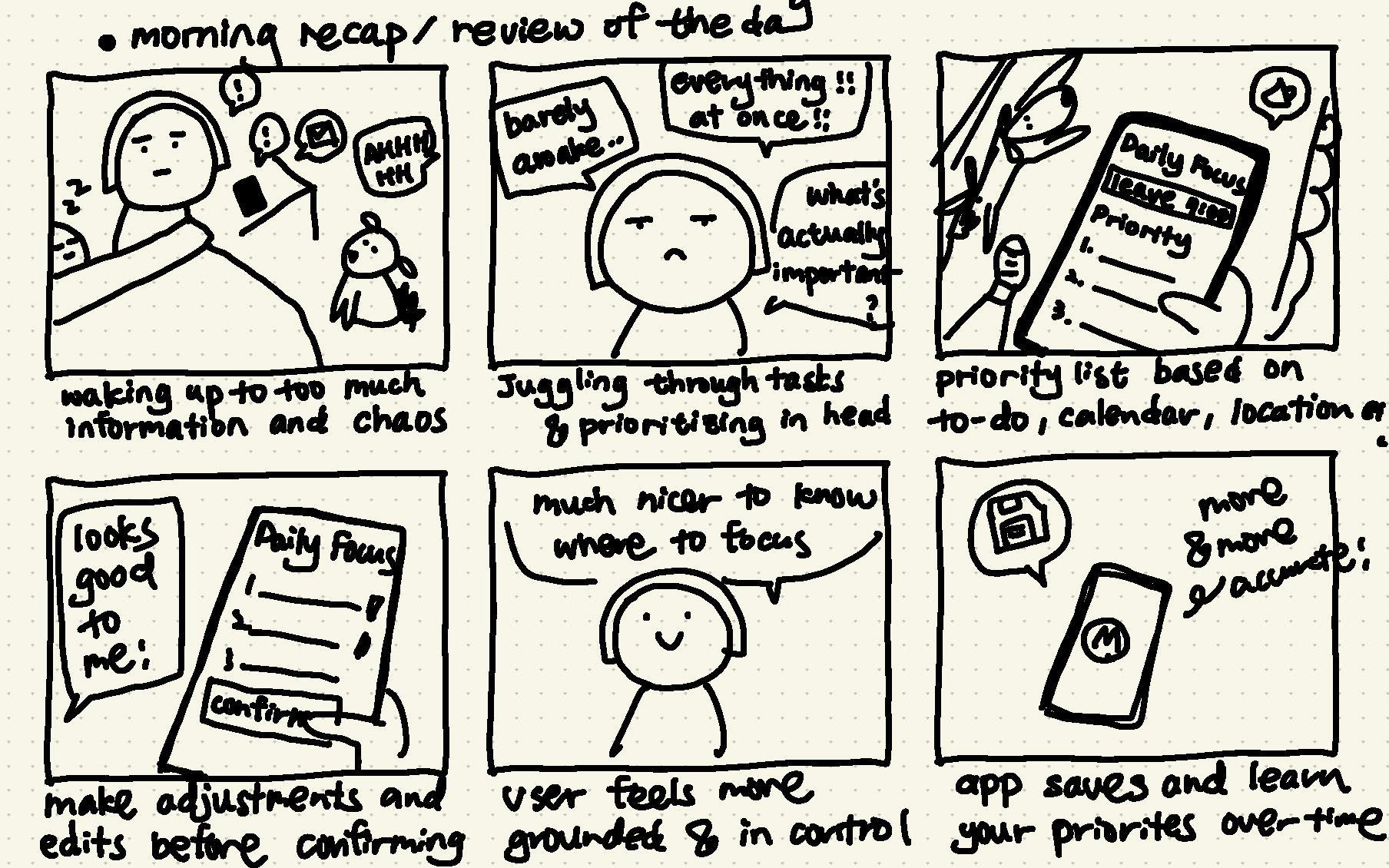
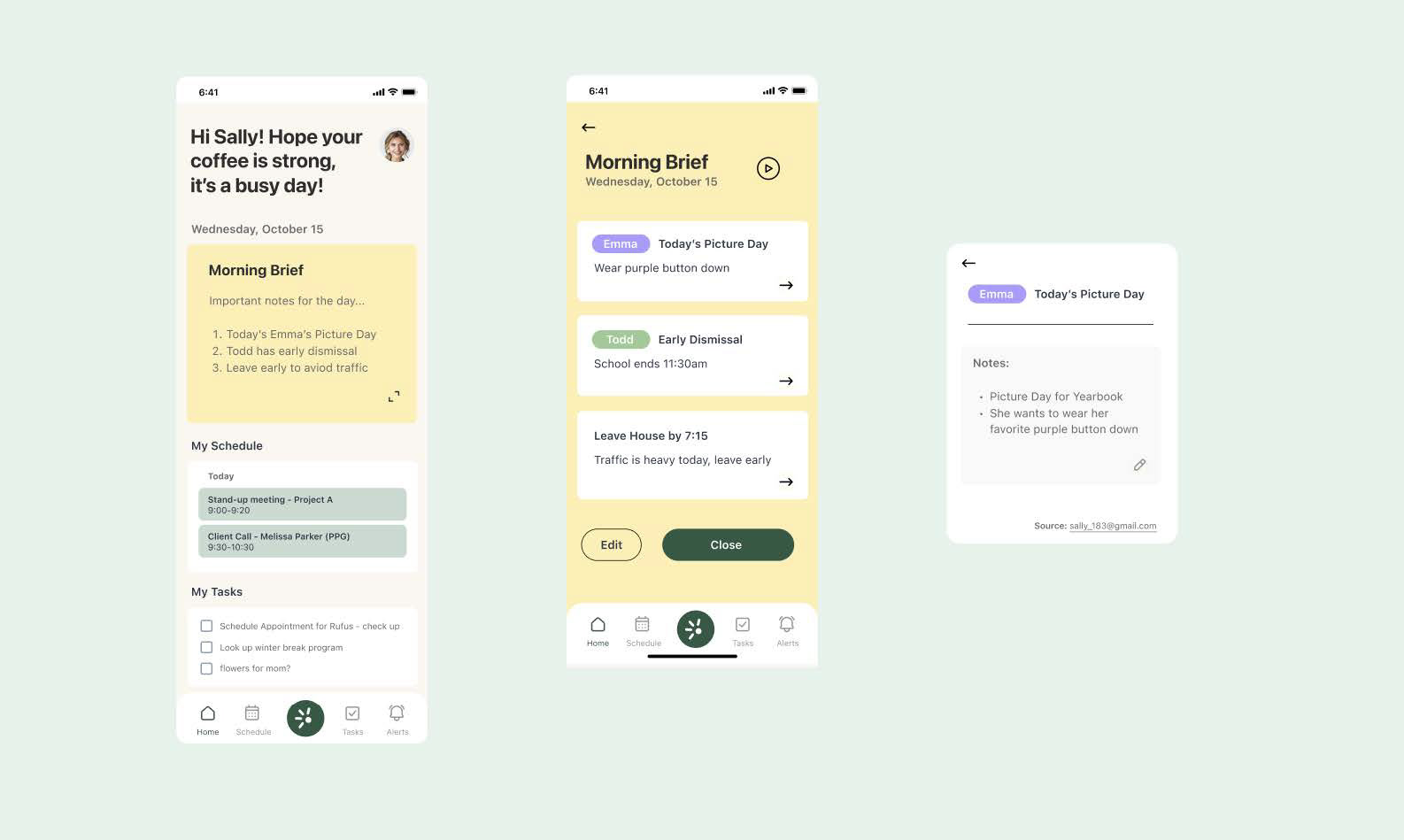
Concept 1: Morning Recap / Daily Focus
Many of our participants mention that mornings are the most stressful time of the day. Juggling tasks and getting everyone out the door.
This concept aims to reduce morning overwhelm by shifting prioritization from the user’s head to a supportive system. By surfacing only the most important or unusual items for the day, the Daily Focus helps parents feel more grounded, confident that nothing critical is missed, and better prepared to handle the day ahead.
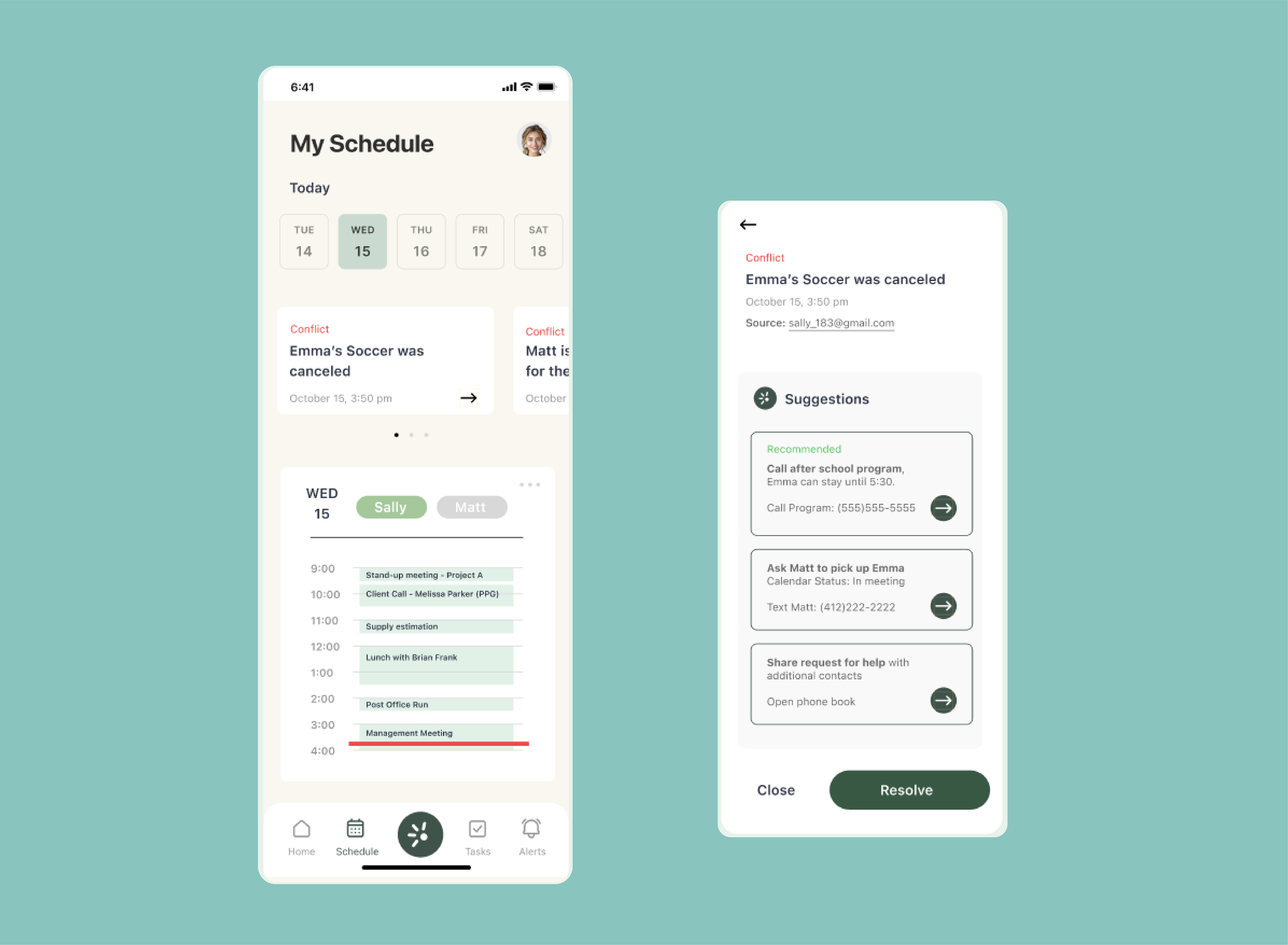
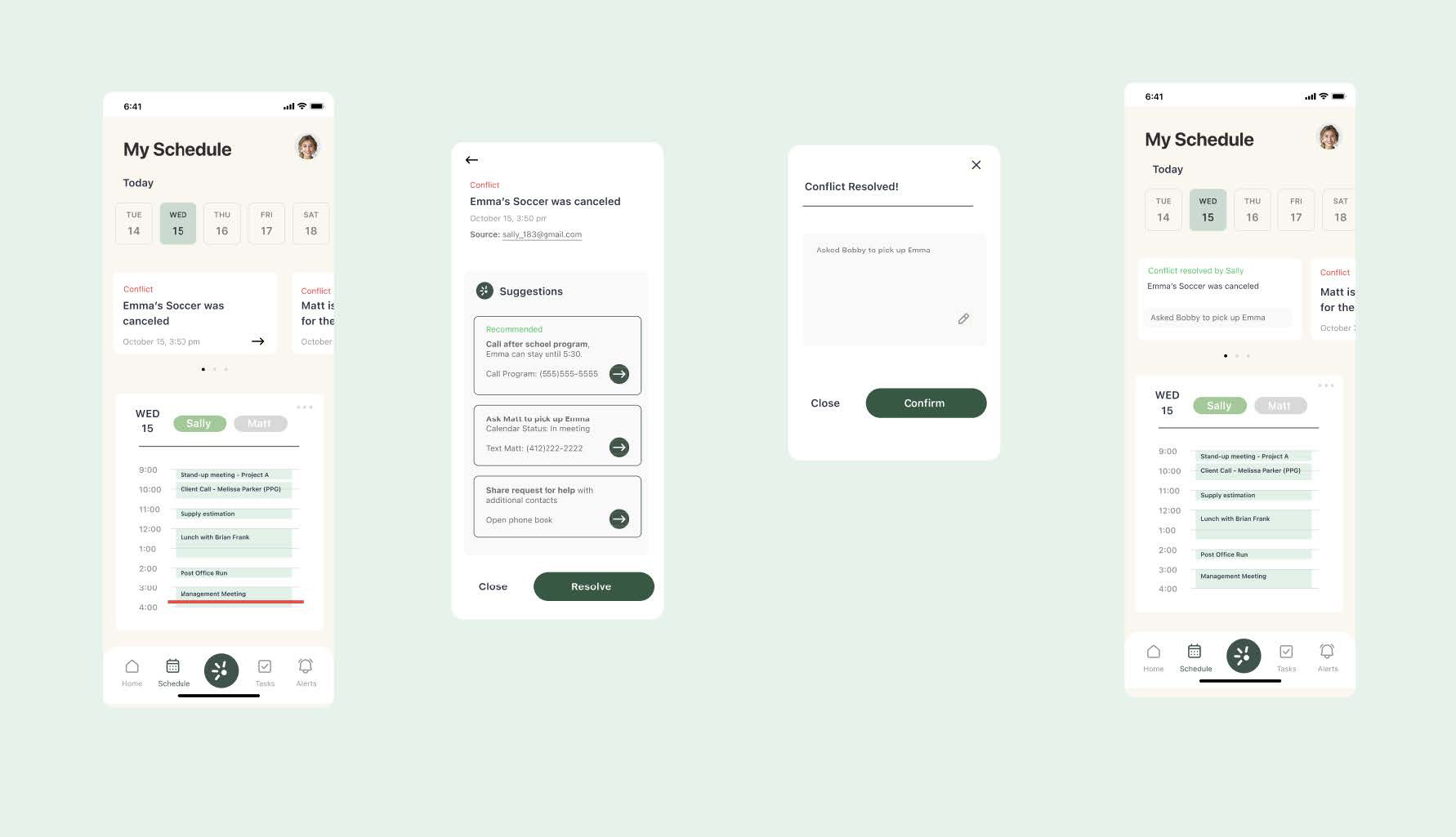
Concept 2: Conflict Resolution & Problem Solving
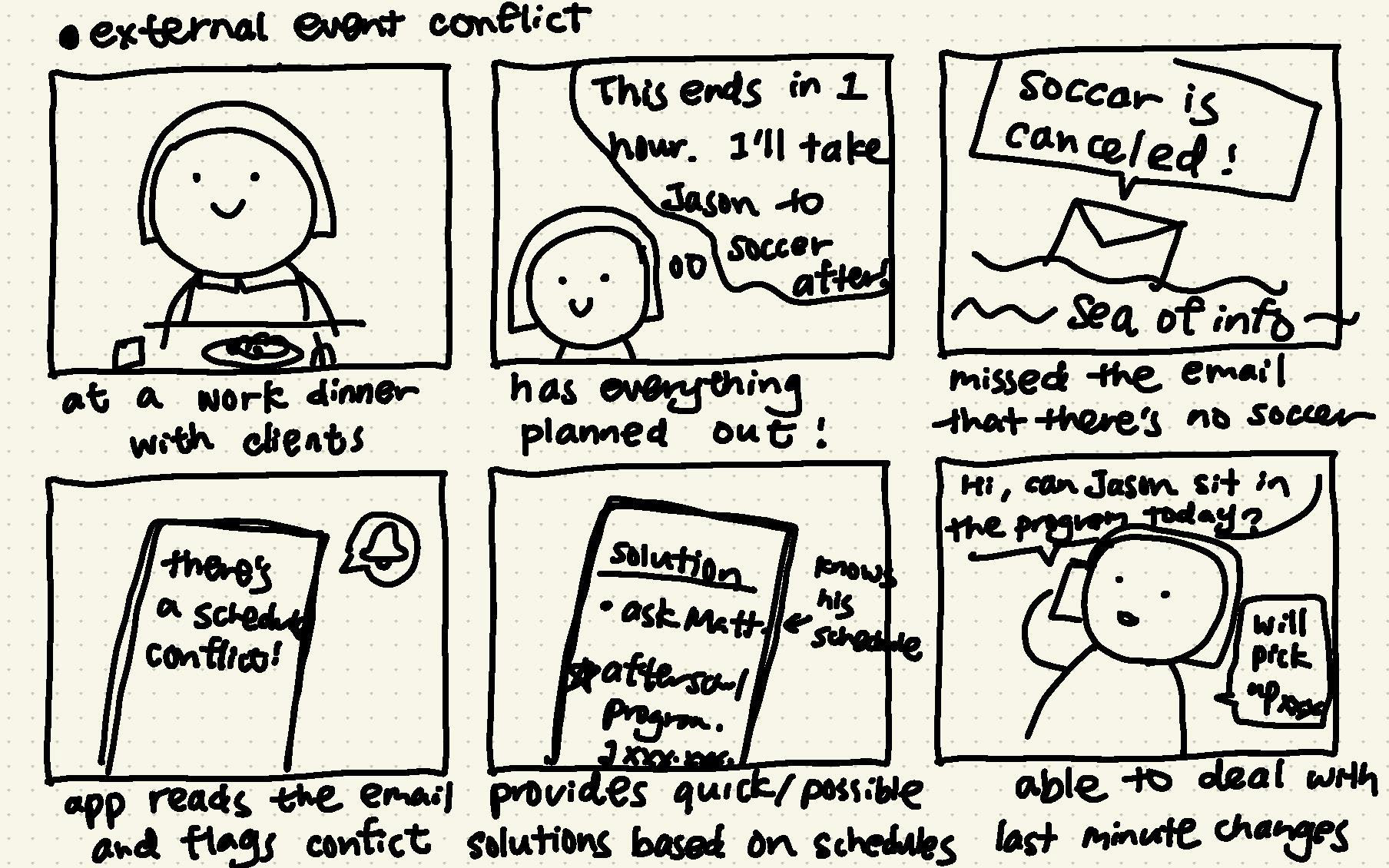
This concept focuses on supporting parents during moments of disruption, which research shows are especially stressful. The goal is not to automate decision-making, but to reduce the cognitive effort required to identify problems, gather information, and take action. By making conflicts visible and actionable, the system helps parents respond more calmly and efficiently to last-minute changes.
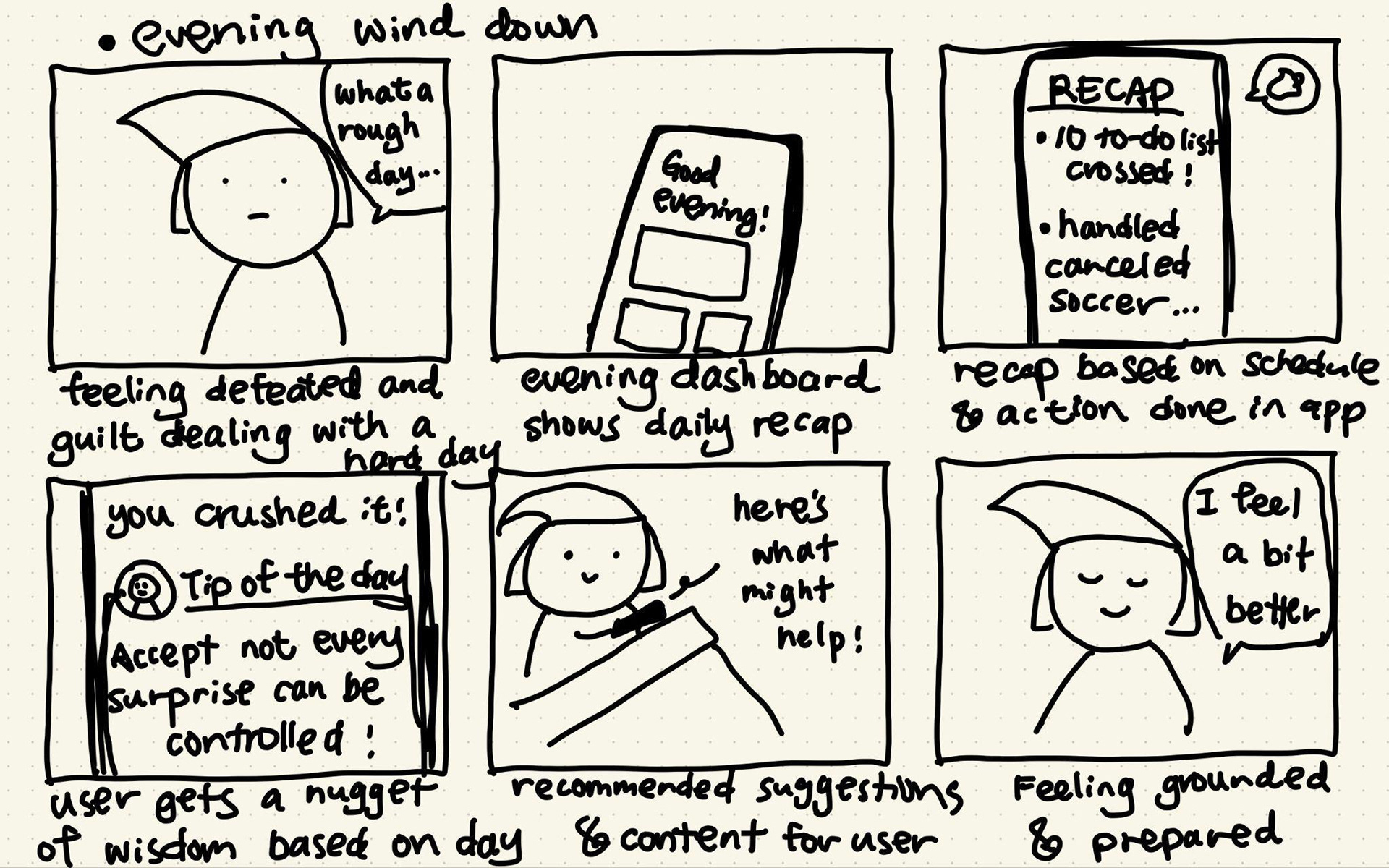
Concept 3: Evening Wind Down & Reflections
This concept addresses the emotional side of mental load. By acknowledging progress and providing perspective, the Evening Wind Down helps reduce guilt, reinforce a sense of accomplishment, and support emotional recovery. Over time, this reflective moment may also help users feel more prepared and less reactive in future days.
What this project taught me about designing AI: Start with the human
Going into this project, I thought the hardest part would be designing AI features.
It turned out the harder problem was understanding where AI belonged in the first place.
The interviews reminded me that parents aren't looking for another app to manage. They're looking for a little less to think about.
That perspective shaped the concepts we explored throughout the project.
Rather than designing AI to take over decisions, I focused on ways it could bring together scattered information, reduce repetitive planning, and give parents confidence that they hadn't missed something important.
It's a mindset I've carried into later projects as well: This project reinforced something I'll carry into future AI work: start with the human problem first. Only then decide whether AI belongs in the solution.